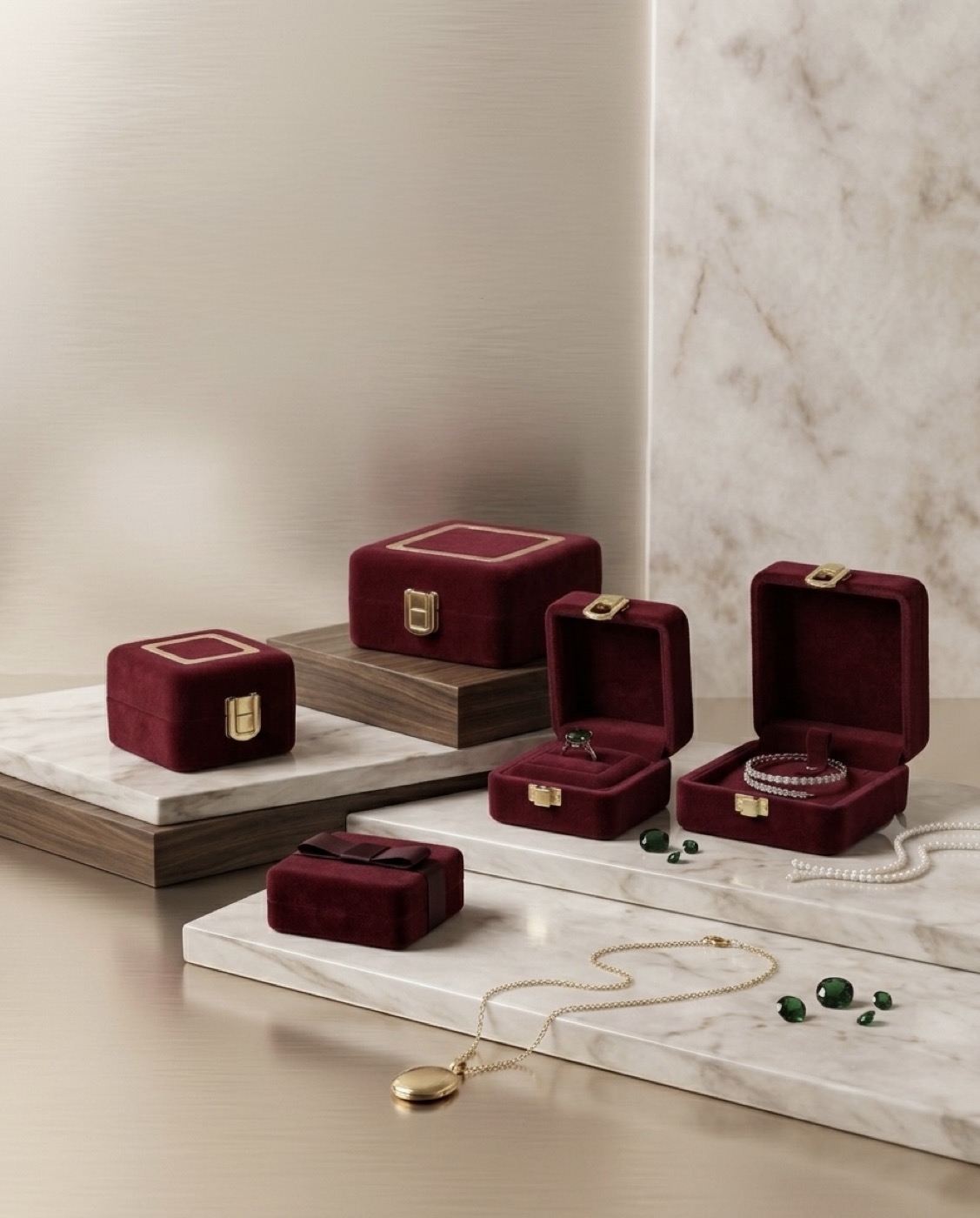
Hot-stamp foil
A heated brass die presses a metallic foil into the surface. The foil transfers where the die touches and nowhere else, so the edge is as sharp as the die is. Gold and silver are the usual finishes; the foil range also runs to copper, rose, black and white.
It is the most common method because it reads clearly at arm's length on a counter. It works best on leatherette, board and coated finishes. On a long-nap velvet the foil sits on top of the pile rather than into it, and it will shed with handling — which is why velvet exteriors usually carry a plate instead.
The die is made once from your artwork and kept on file. Fine serifs and hairlines need a deeper die than a solid block does, or the detail closes up.
Blind deboss
The same brass die, without foil. The logo is pressed into the material and reads as a shadow rather than as a colour.
This is the quietest option and the one most often chosen when the box is meant to be understated, or when the brand colour is already doing the work. It needs a material with enough body to hold the impression — leatherette, leather and board hold it; a thin fabric wrap does not.
Depth matters more than size. A shallow deboss on a textured surface disappears; on a smooth surface the same depth reads clearly.
Metal plate
A separate metal badge, etched or engraved with your logo, set into a recess in the lid or fixed to the surface. Finishes run from polished gold and brushed steel to black nickel.
A plate is the answer when the surface will not take a stamp — velvet, suede with a long nap, or a lacquer that foil cannot bond to. It also survives handling better than anything else, which is why it is common on travel cases and on boxes that live on a counter for years.
It is the only method that adds a component rather than marking the surface, so it changes the feel of the lid as much as the look of it.
Engraving
Cut into the material rather than pressed into it. On lacquered wood the lacquer is cut through to the layer beneath; on metal the mark is machined.
This is the method for hard surfaces where a die cannot make an impression. It is permanent, it does not wear, and on a polished lacquer it is the only mark that does not risk lifting.
Single-colour silk screen
Ink pushed through a mesh screen. It lays colour on the surface rather than marking it, which means it can print a logo that a die cannot — a solid shape, a flat colour that is not metallic, or a mark on a material that will not take an impression.
The screen is made once from your artwork. Our silk-screen plate is a one-time US$50 charge, and the same screen is used for every repeat order of that logo.
Screen printing is one colour at a time. A two-colour logo means two screens and two passes, registered to each other.
At a glance
| Method | Tool needed | Suits | Avoid on |
|---|---|---|---|
| Hot-stamp foil | Brass die | Leatherette, board, coated leather | Long-nap velvet |
| Blind deboss | Brass die | Leather, leatherette, board | Thin fabric wraps |
| Metal plate | Etched badge | Velvet, suede, lacquer, travel cases | Very thin lids |
| Engraving | Cutter | Lacquered wood, metal | Fabric and board |
| Silk screen | Mesh screen | Most flat surfaces | Deep textures |
Frequently asked questions
Which logo method lasts longest?
A metal plate, because it is a component rather than a mark on the surface. Engraving on lacquer or metal is equally permanent. Foil and deboss both wear slowly with handling, which on most counter boxes is measured in years rather than months.
Can I put my logo inside the box as well as outside?
Yes. An interior logo is usually foil or a printed lid card. On a suede or velvet lining a printed card is more reliable than a stamp, because the lining is soft and the impression will not hold.
Do I need to supply artwork in a particular format?
Vector artwork — an AI, EPS or PDF file — gives the cleanest die and the cleanest screen. A high-resolution image can be redrawn, but redrawing is an interpretation and it should be approved before the tool is made.
Can the same logo be used across different materials?
Usually, but not always at the same size. A fine mark that reads well debossed into leather may close up on a textured board, and the same mark screened on suede will need to be slightly heavier. We check this on the sample before production.
Tell us what you need
Tell us the ring, your brand and the quantity — we'll send photos of our work and one clear, all-in quote.