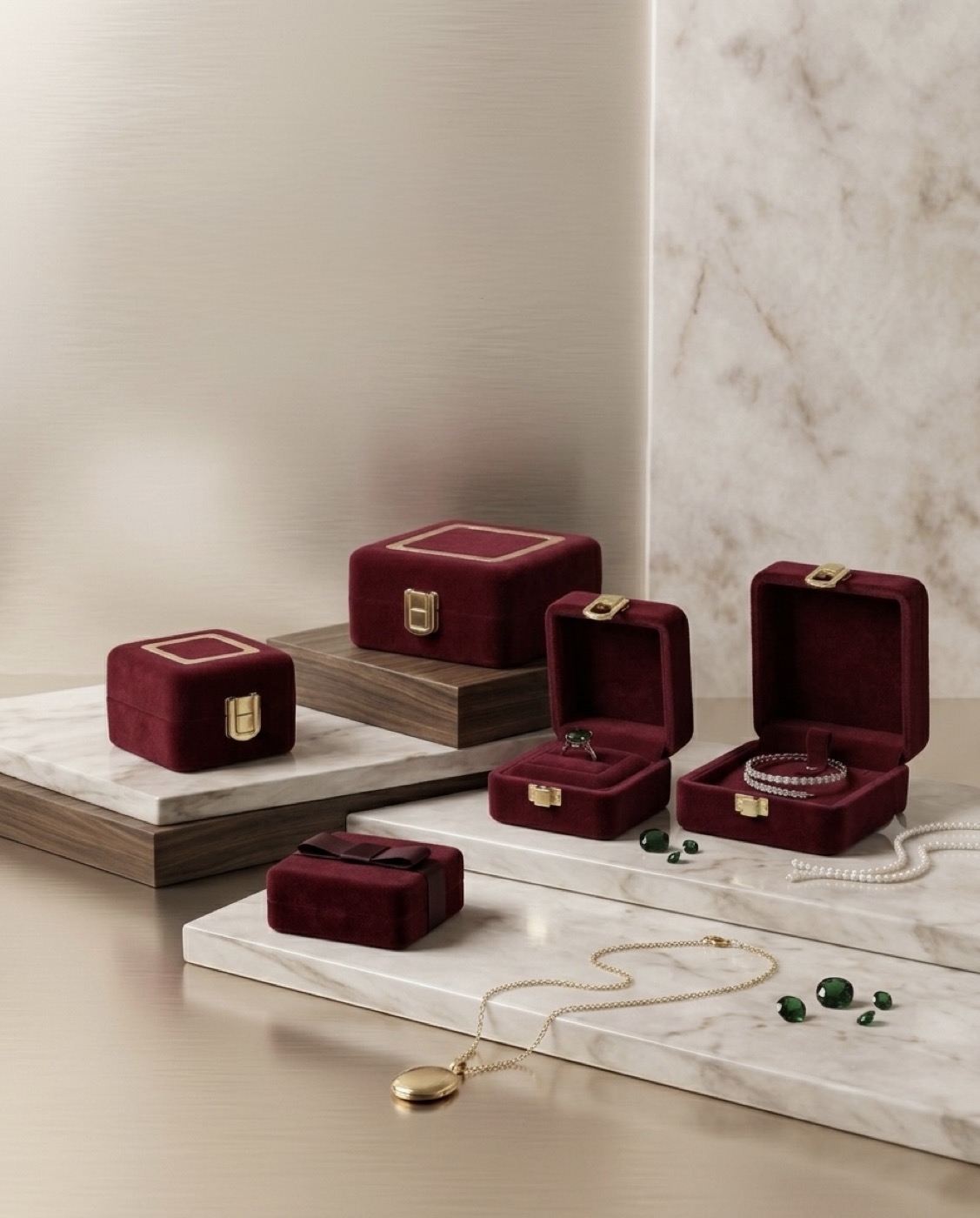
The ring slot
Two covered foam pads set side by side with a cut between them. The ring is pushed down into the cut and the foam closes on the shank under its own spring.
The cut is what does the work. Too wide and a thin band falls through and lies flat; too narrow and a heavy signet shank will not seat, or it seats and then will not come out cleanly in front of a customer. The same box usually has to take both, so the cut is set to hold the range rather than one ring.
The pads are covered in the lining material, which is cut a fraction under size on each face — the nap closes the gap and there is no visible seam at the cut.
The pillow and the C-cushion
A pillow is a padded roll. A bangle or a watch is passed over it and the roll holds the piece open and off the base.
A C-cushion is a pillow with a curved seat cut into it. A wide cuff or a rigid bangle sits down into the curve instead of resting on top of a round roll — which is the difference between the lid closing and the lid pressing on the piece.
Both are cut to the inner diameter of the piece. A bangle measurement, or a photograph against a ruler, is enough to get it right first time.
The hanging board
A pendant is held against a board by a slit or a hook near the top, with the chain dressed down either side. It presents the piece the way it is worn rather than lying flat.
The board has to be sized to the drop of the pendant, not to the box. A short drop on a tall board leaves the piece floating; a long drop on a short board means the pendant sits on the base and the chain slackens.
The chain keeper
A clip, a slot or a small covered post that holds the clasp so a long chain cannot travel inside the box.
This is the single most useful thing in a necklace box that ships. Without it a long chain arrives gathered at one end, and the customer opens the box to a knot. The keeper is positioned to the chain length, so a box made for a 45 cm chain will not hold an 80 cm rope the same way.
The parure tray
A single opening that holds a full suite — necklace, earrings, ring and sometimes a bracelet — each in its own seat.
A parure tray is drawn to the specific set. It is not a stock layout, and a different suite will need a different tray even inside the same outer box. Buyers usually send photographs of the pieces laid out before the tray is drawn.
Die-cut foam versus moulded
Most interiors are die-cut: layers of foam cut with a steel rule die, then wrapped. This is the flexible route — a new shape means a new die, not a new mould.
A moulded interior is formed in a tool. It gives a cleaner curve and repeats perfectly, and it is the right answer for a shape that will be made again and again. The decision between them is usually about whether the shape is settled.
At a glance
| Interior | Holds | Designed to prevent |
|---|---|---|
| Ring slot | Rings, from thin bands to signets | The ring lying flat or falling through |
| Pillow | Bangles, watches, cuffs | The piece rolling in the box |
| C-cushion | Wide or rigid bangles | The lid closing on the piece |
| Hanging board | Pendants | The pendant lying face-down |
| Chain keeper | Long chains, tennis bracelets | The chain arriving knotted |
| Parure tray | A full suite | Pieces touching each other |
Frequently asked questions
Can one box hold more than one type of piece?
Yes — a set box does exactly that, with a separate seat for each piece in one opening. What it cannot do is hold pieces of very different depths in the same plane; a ring and a cuff usually need either different depths of seat or a tiered interior.
What do you need from me to cut an insert?
The piece dimensions, or the piece itself, or a clear photograph against a ruler. For rings, the widest shank you expect to sell in that box. For pendants, the drop. For bangles, the inner diameter.
Will the insert mark the piece?
It should not. Microfibre suede and velvet linings are chosen partly because they do not abrade — this matters most with pearls and with soft stones. Where a piece is unusually delicate we will say which lining to use.
Can the interior be changed later without changing the box?
Often, yes. If the outer shell stays the same, a new interior is a new die rather than new tooling for the whole box. This is the usual way a range grows.
Tell us what you need
Tell us the ring, your brand and the quantity — we'll send photos of our work and one clear, all-in quote.