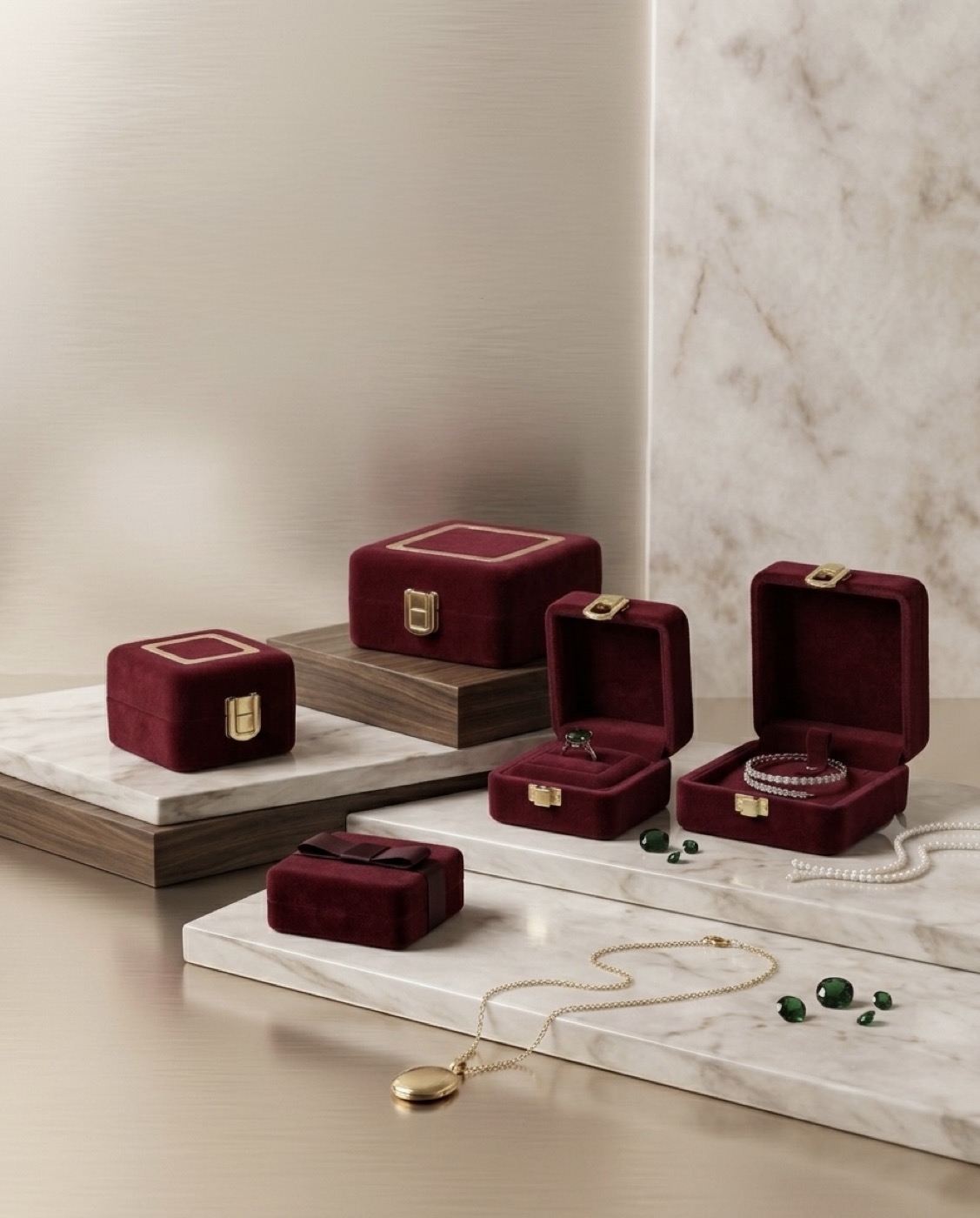
Rings
We need the widest shank you expect the box to hold, not the ring you happen to have on the desk. A box cut for a 1.5 mm wedding band will not take a 4 mm signet; a box cut for the signet lets the band lie over.
If the box is for a range rather than a single piece, tell us the two extremes. The slot is then set to hold both, which is a different cut from one set to a single width.
Pendants and necklaces
For a pendant, the drop — the vertical measurement from the top of the bail to the bottom of the piece. That decides the height of the hanging board.
For a necklace, the chain length. A keeper positioned for 45 cm will not hold 80 cm the same way. If the box has to take several lengths, say so, and the interior is designed around the range.
Bangles, cuffs and watches
The inner diameter for a bangle or a cuff, and whether it is rigid or hinged. A rigid bangle needs a curved seat; a flexible one can sit over a round pillow.
For a watch, the case diameter and the strap type. A deployant clasp needs more room over the cushion than a pin buckle does.
Sets
For a suite, we would rather see a photograph of the pieces laid out the way you want them presented than a list of dimensions. The layout is the design decision; the measurements follow from it.
The three mistakes that cost a sample round
Measuring the piece instead of the range. The box will be used for more than one item. Give the extremes.
Forgetting the depth. A ring is not flat. A raised setting needs clearance under the lid, and it is the measurement most often left out.
Sizing from an existing box. If you send an old box and ask for the same, we will match it — but if the old box was slightly wrong, the new one will be wrong in the same way. Measure the piece.
At a glance
| Piece | What we need | Most often forgotten |
|---|---|---|
| Ring | Widest shank width | Height of the setting |
| Pendant | Drop from bail to base | Bail thickness |
| Necklace | Chain length | Clasp size |
| Bangle | Inner diameter | Rigid or hinged |
| Watch | Case diameter, strap type | Clasp depth |
| Set | A photograph of the layout | Which piece leads |
Frequently asked questions
Can I just send you the piece?
Yes, and it is the most accurate route. We measure it, make the sample around it and return the piece with the sample.
What if I do not have the piece yet?
Send the technical drawing or the CAD file. If neither exists, send the closest piece you have and tell us how the new one differs.
Do you need metric or imperial?
Either. We work in millimetres, and we will convert. What matters is that the measurement is of the piece, not of a box that once held it.
How accurate does the measurement have to be?
Close enough to cut a first sample. The sample is where the fit is confirmed — that is what it is for. A measurement to the nearest millimetre is almost always enough to start.
Tell us what you need
Tell us the ring, your brand and the quantity — we'll send photos of our work and one clear, all-in quote.