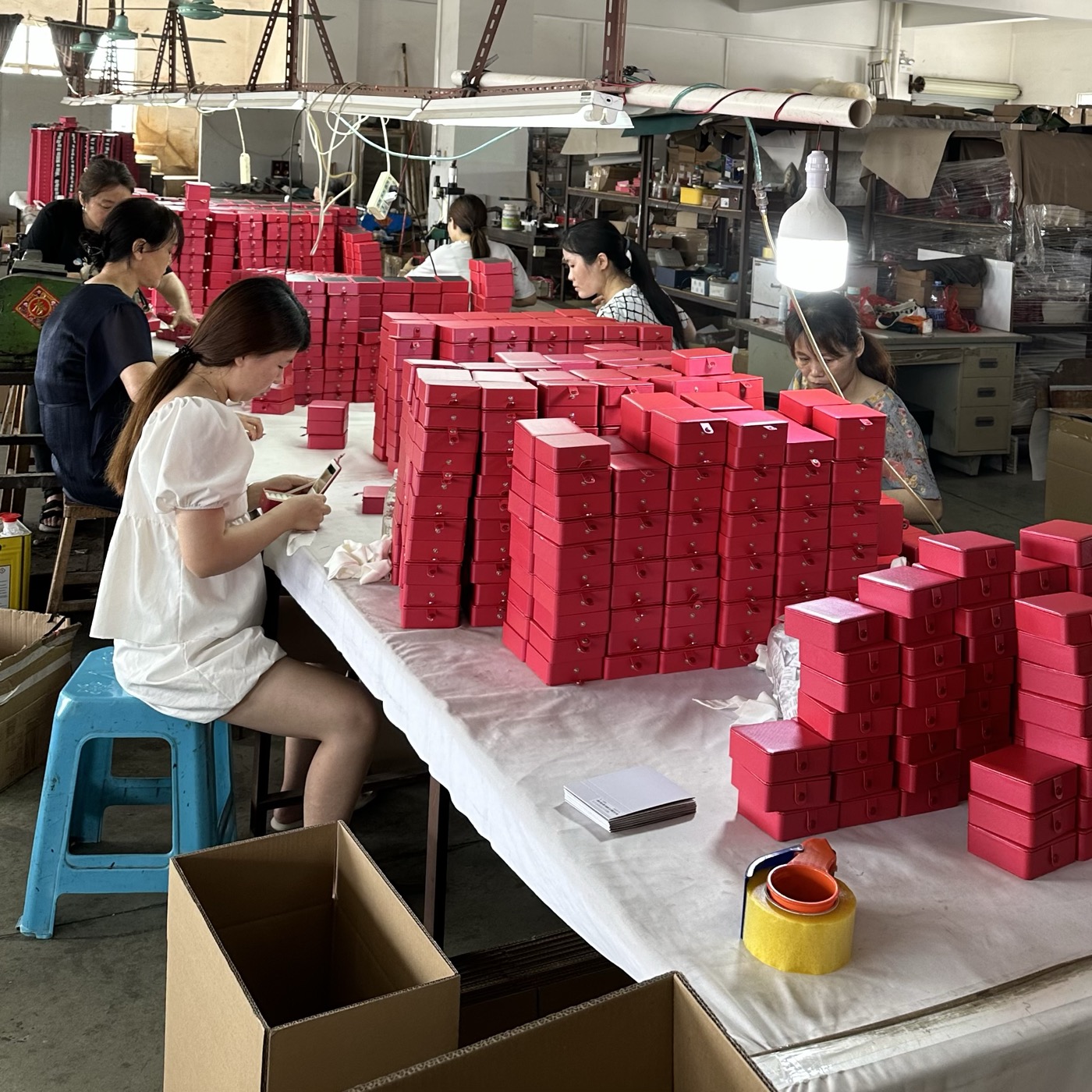
The board shell
Greyboard is cut on a steel rule die and formed into the base and the lid. This is the structure — the thickness of the board is what makes a box feel substantial or hollow, and it is decided before anything else.
Everything after this is applied to the shell.
The wrap
The covering material — paper, leatherette, velvet, suede or hide — is cut, glued and wrapped around the shell, with the corners folded and the edges turned in.
Corners are where wrapping quality shows. A material that is thick or stiff folds differently at a corner than a thin paper does, which is why the same design in two materials is not the same job.
Branding
Deboss, hot foil or screen print is applied. On a wrapped box this is usually done to the wrap before or after wrapping depending on the material and the mark, and the choice affects how crisp the result is.
Fine detail favours a die on a smooth material; a nap material like velvet takes a mark differently and is better suited to a plate or a printed element.
The interior
The insert is built separately — board, foam and a lining — and cut to the piece. A ring slot, a watch cushion, a pendant board or a plain pad are all versions of the same step.
The interior is where the piece is protected and where most of the specification is spent.
Assembly and finishing
The interior is fitted into the shell, hardware is added if the design uses it, and each box is checked and closed. From here it goes to packing.
At a glance
| Step | What is decided |
|---|---|
| Board shell | Thickness, and how substantial the box feels |
| Wrap | Material, colour, and how corners will look |
| Branding | Deboss, foil or print, matched to the material |
| Interior | Fit to the piece — where most of the specification goes |
| Assembly | Hardware, checking, packing |
Frequently asked questions
What makes a box feel substantial?
Board thickness, decided before anything else. Wrap and interior do not compensate for a thin shell.
Why does the same design cost differently in two materials?
Because a thick or stiff material folds differently at a corner than a thin paper, so the wrapping work is not the same job.
Can any logo method go on any material?
No. Fine detail suits a die on a smooth material; a nap material like velvet takes a mark differently and often suits a plate or a printed element.
Is the interior made separately?
Yes. It is built as its own part and fitted into the shell, which is why it can be changed without changing the shell.
Tell us what you need
Tell us what you are making and what it has to hold. We’ll tell you what it takes and send one clear, all-in quote.