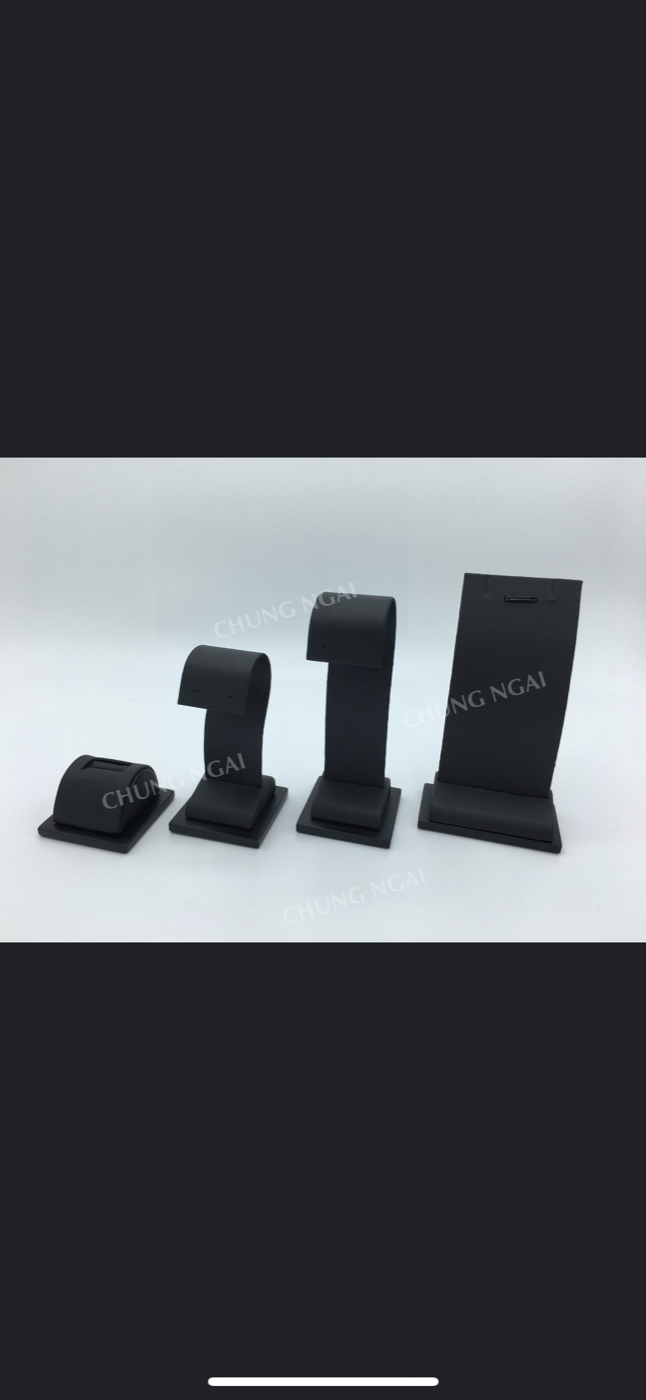
What it does
An easel stand is a sloped face on a small base, and a piece or a card leans against it. It is the simplest way to bring something up off a flat tray and angle it toward a standing customer.
Velvet on a easel stand, specifically
Velvet on the sloped face gives enough grip that a pendant or a card will hold at a steeper angle than any smooth facing allows. That lets the easel be more upright, which reads better to a standing customer.
Getting the proportion right
The angle is the whole specification. Too upright and the piece slides off; too shallow and it reads as lying down. The right angle depends on whether the customer is standing at a counter or looking down into a case, and those are different numbers.
How velvet is applied to a display form
Velvet is glued over the form and the pile has to run the same way on every face, or one side of the same block reads darker than the other. On a curved form it is cut in panels rather than stretched, because pile flattens where it is pulled.
Where it is used
Pendants, cards, certificates and single showpieces, in counters and windows. It is also the standard way to present a signed or credited piece where the text has to be read alongside it.
Velvet under case lighting
Pile absorbs light instead of bouncing it, so a velvet display sinks into the background and the piece on it becomes the brightest thing in the case. It also means the display itself photographs dark, which suits a shop and not a catalogue shot.
The mistake to avoid
An easel with no lip at the base is the most common mistake we correct. Without it, anything with a smooth back travels down the slope as soon as the case is knocked.
Why velvet
Velvet-covered display reads as traditional and formal. The pile absorbs light rather than reflecting it, so the piece on top is the brightest thing in the case.
The pile shows handling and dust. Velvet display belongs behind glass, brushed regularly; on an open counter it ages faster than suede.
What we need from you
| What we need | Why |
|---|---|
| Height and footprint | The angle is the whole specification. |
| Velvet colour | Matched to a Pantone reference or a swatch |
| Velvet on this form | Velvet on the sloped face gives enough grip that a pendant or a card will hold at a steeper angle than any smooth facing allows. |
Frequently asked questions
Can easel stands be made in our brand colour?
Yes — the velvet is matched to a Pantone reference or a physical swatch, and confirmed on a sample.
What sizes do easel stands come in?
They are made to your dimensions. The angle is the whole specification. Too upright and the piece slides off; too shallow and it reads as lying down. The right angle depends on whether the customer is standing at a counter or looking down into a case, and those are different numbers.
Is velvet a good choice for a easel stand?
Velvet on the sloped face gives enough grip that a pendant or a card will hold at a steeper angle than any smooth facing allows. That lets the easel be more upright, which reads better to a standing customer.
What goes wrong most often with easel stands?
An easel with no lip at the base is the most common mistake we correct. Without it, anything with a smooth back travels down the slope as soon as the case is knocked.
Can easel stands be made to match our boxes?
Yes — the same velvet and the same colour across boxes and display, ordered in one run.
Specify your easel stands
Tell us your case or window height, what the easel stands have to show, and your brand colour. We’ll send photos of our work and one clear, all-in quote.