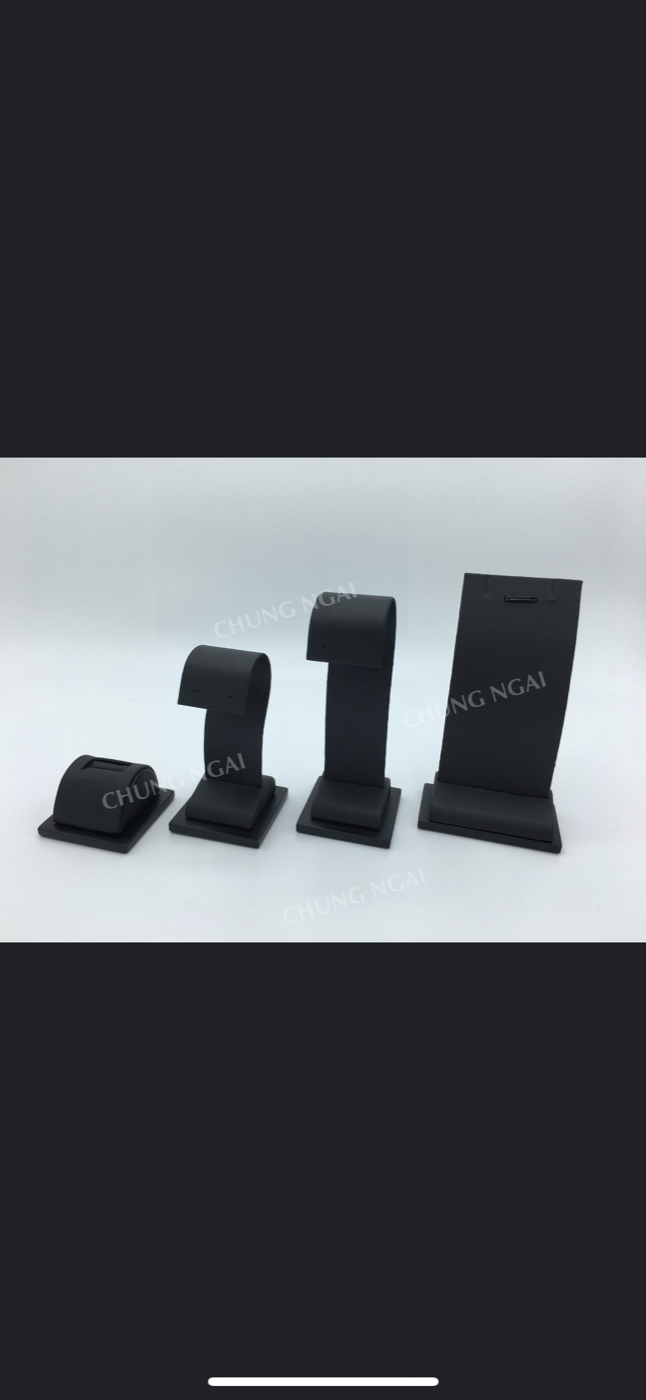
What it does
A T-bar is an upright with a horizontal arm, and pieces hang over the arm rather than sitting on a surface. It shows a bracelet or a watch at its worn curve instead of flat, which is the only way a hinged bracelet reads correctly in a case.
Metal on a t-bar, specifically
Metal is the material that lets a T-bar be cantilevered from a small base without looking heavy. It is also hard against a clasp, so the bearing face should be faced or sleeved.
Getting the proportion right
The arm diameter decides what it suits. A fine arm takes a light chain bracelet and looks wrong under a heavy cuff; a thick arm holds a watch at its natural curve and will not take anything delicate. Most counters end up with two diameters rather than one.
How metal display is made
Metal display is formed and plated or powder-coated rather than covered. The finish is decided at the plating stage and cannot be adjusted afterwards, so the sample matters more here than on any wrapped material.
Where it is used
Counter cases for bracelets and watches, and window work where several pieces have to be read at the same height. It is also the display most often ordered in a graded set of three.
Metal under case lighting
A polished metal display throws hard reflections and will bounce a spot straight back at the customer. Brushed and matt finishes are the usual specification in a lit case; polish belongs in a window where the light is controlled.
The mistake to avoid
The common failure is an arm that is too long. Pieces slide to the outer end under their own weight and the display ends up lopsided, and the fix is a shorter arm or a slight upward angle, not a stopper.
Why metal
Metal display — brass, gold finish, black or silver — gives the thinnest possible support. A metal stand almost disappears, which is the point: the piece appears to float.
Wipe with a dry cloth. A brushed finish hides handling better than a polished one.
What we need from you
| What we need | Why |
|---|---|
| Height and footprint | The arm diameter decides what it suits. |
| Metal colour | Matched to a Pantone reference or a swatch |
| Metal on this form | Metal is the material that lets a T-bar be cantilevered from a small base without looking heavy. |
Frequently asked questions
Can T-bars be made in our brand colour?
Yes — the metal is matched to a Pantone reference or a physical swatch, and confirmed on a sample.
What sizes do T-bars come in?
They are made to your dimensions. The arm diameter decides what it suits. A fine arm takes a light chain bracelet and looks wrong under a heavy cuff; a thick arm holds a watch at its natural curve and will not take anything delicate. Most counters end up with two diameters rather than one.
Is metal a good choice for a t-bar?
Metal is the material that lets a T-bar be cantilevered from a small base without looking heavy. It is also hard against a clasp, so the bearing face should be faced or sleeved.
What goes wrong most often with T-bars?
The common failure is an arm that is too long. Pieces slide to the outer end under their own weight and the display ends up lopsided, and the fix is a shorter arm or a slight upward angle, not a stopper.
Can T-bars be made to match our boxes?
Yes — the same metal and the same colour across boxes and display, ordered in one run.
Specify your T-bars
Tell us your case or window height, what the T-bars have to show, and your brand colour. We’ll send photos of our work and one clear, all-in quote.